Material guide
Large or small format: which creates less waste?
Small formats, by a clear margin – and the margin is larger than most expect. We ran each of the 500 rooms in our analysis through eight formats, same joint, same laying, same starting point. Result: 20 × 20 gets by with a median surplus of 0.3%, 60 × 120 needs 17.4%. In 427 of 500 rooms the smallest format was the most economical. Whether that is the right choice is another matter – this article only supplies the numbers.
The planning tool opens after free sign-up.
By the floorplanning.app editorial team
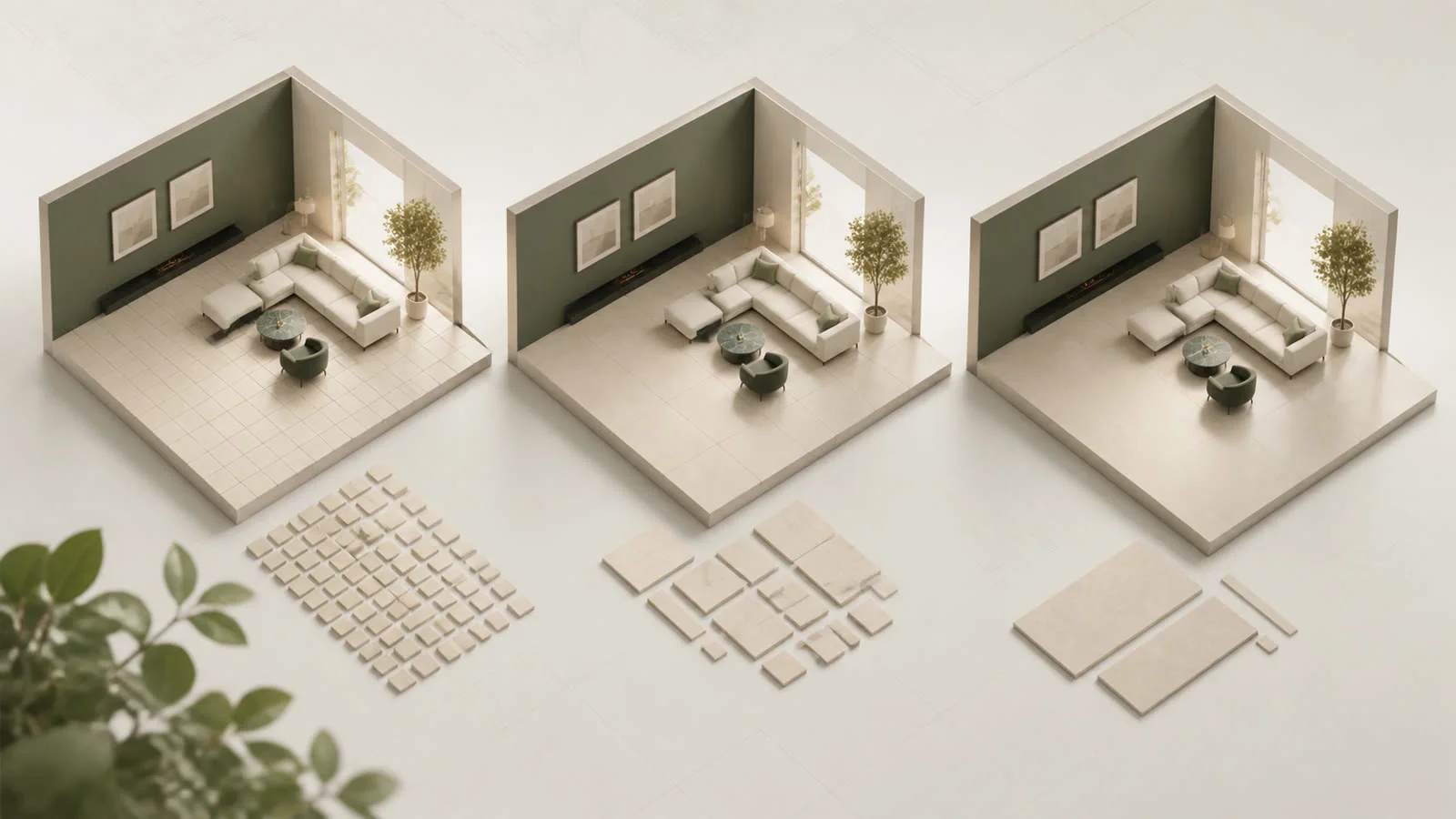
Why small formats win
Waste occurs at the edge, and the edge is always the same length. The smaller the tile, the narrower the strip lost per border tile. A cut 20 cm tile loses at most 0.04 m², a cut 60 × 120 up to 0.72 m². At the same perimeter length, that is the entire difference.

What matters in practice

The same room, 140 versus 21 tiles
4.00 × 3.00 m, so 12 m²: with 30 × 30 you need 140 tiles and end up 5.0% above the room area. With 60 × 120 it is 21 slabs – and a 26.0% surplus. In square metres: 12.6 versus 15.1. Two and a half square metres you buy and do not lay.
The price per square metre is not the price
Two tiles at €30/m² do not cost the same if one produces a 26% surplus and the other 5%. For 12 m² of room area that is 15.1 versus 12.6 purchased square metres – about €75 difference at €30/m², with no change to the shelf price. Build the surplus into your comparison before deciding.
What the numbers do not say
Small formats save material and cost working time: laying and grouting 140 tiles takes considerably longer than 21 slabs. Anyone hiring a tradesperson pays the difference back twice. Large formats also demand a flatter substrate – tolerances shrink with edge length, they do not grow. The material calculation is only one side.

The order is not the size order
The outlier is interesting: 20 × 120 (wood effect) comes in worse at 9.1% than 45 × 45 at 6.7%, although the tile has less area. Long narrow formats lose disproportionately at their short ends. It is not the tile’s area alone that decides but how its edges fit the room.
All eight formats compared directly
Each of the 500 rooms run with every format, 3 mm joint, straight laying, flush wall start, offcuts reused. Same rooms, same conditions – only the format changes.
| Format | Median | Top tenth | Above 10% | Cheapest format in … rooms |
|---|---|---|---|---|
| 20 × 20 cm | 0.3% | 4.0% | 1% | 427 |
| 30 × 30 cm | 3.5% | 8.4% | 5% | 56 |
| 30 × 60 cm | 6.2% | 14.1% | 22% | 0 |
| 45 × 45 cm | 6.7% | 15.8% | 28% | 10 |
| 20 × 120 cm | 9.1% | 20.4% | 43% | 7 |
| 60 × 60 cm | 10.1% | 23.3% | 51% | 0 |
| 80 × 80 cm | 14.9% | 35.4% | 73% | 0 |
| 60 × 120 cm | 17.4% | 35.8% | 79% | 0 |
What the format choice really costs
The material surcharge is only one of three costs. Choosing a format simultaneously decides laying time and the demands on the substrate.
- Small formats save material: 20 × 20 a median of 0.3%, 60 × 120 17.4%
- Large formats save time: 21 instead of 140 tiles in a 12 m² room
- Large formats demand a flatter substrate
- Long narrow formats perform worse than their area suggests
How to compare properly
1. Compare purchased quantity
Do not calculate room area × price but purchased area × price.
2. Swap through formats
Test several formats on your own plan instead of trusting rules of thumb.
3. Factor in time
With a contractor, treat the piece count as a cost driver.
Examples from the tool
This is what it looks like planned out
The numbers above do not come from a spreadsheet but from a real layout. You can open these example projects directly – floor plan, laying plan and material list, exactly as the tool outputs them.

Format comparison: 60 × 60 vs 30 × 60
Two identically sized rooms side by side, only the format differs – each with its own row in the material table. Here the smaller format needs more material, because room dimensions decide, not tile size alone.
- 2 × 13.49 m² · 8% reserve
- 60 × 60 → 46 tiles = 16.6 m²
- 30 × 60 → 98 tiles = 17.6 m²

Small bathroom with tub and stud wall
Under 3 m² of floor left, but two cutouts: this room produces more cut tiles than full ones – exactly where the m² rule of thumb fails.
- 2.82 m² · 30 × 60 · 2 mm joint
- 9 full tiles, 22 cuts
- 35 tiles incl. 10% reserve
Opens the read-only client view of a share – the same one you create for your own projects with Premium.
Common questions
Which tile format has the least waste?
The smallest. In our comparison across 500 rooms, 20 × 20 had a median surplus of 0.3%, 30 × 30 3.5% and 60 × 120 17.4%. In 427 of 500 rooms 20 × 20 was the most economical choice.
Are large formats still worth it?
Often yes – but for other reasons: fewer joints, less laying time, calmer looks, easier cleaning. The material surcharge is the price for that, and it can be quantified. It only becomes a problem if you fail to budget for it and have to reorder mid-project.
Does this apply to rectangular formats too?
Not linearly. Long narrow formats such as 20 × 120 perform worse than their area suggests because they lose a lot at their short ends. What matters is how both edge dimensions fit the specific room – which is why comparing on your own floor plan pays off.
How do I factor waste into a price comparison?
Multiply the purchased quantity, not the room area, by the price per square metre. For a 12 m² room that is about 12.6 m² with 30 × 30 and about 15.1 m² with 60 × 120. Only that comparison shows the real price difference between two tiles.
Does that mean the smaller format always saves material in my room?
No – the median covers 500 rooms, not yours. In the "format comparison" example project above, two identical rooms of 13.49 m² sit side by side: room A with 60 × 60 needs 46 tiles including reserve, about 16.6 m² of material; room B with 30 × 60 needs 98 tiles, about 17.6 m². Here the smaller format loses, because the room dimensions decide the leftover widths. That is exactly why comparing on your own floor plan beats comparing on a table.
Read on
- The 10% rule is wrong: 500 rooms analysedWe ran 500 floor plans through our laying engine. Result: real material surplus ranges from under 2% to over 58%. Method, tables and raw data to…
- Small bathroom: which format looks bigger?Which tile size makes a small bathroom look bigger? Compare large and small formats, layouts, cuts, and waste directly on the floor plan.
- Reusing offcuts: is it worth it?Offcuts save a median of 5.5 percentage points of material – but exactly zero tiles in 143 of 500 rooms. When sorting and re-cutting actually pays…
Compare formats on your own room
Enter your room dimensions and swap through the formats – purchased quantity and waste update immediately.
The planning tool opens after free sign-up.