Material guide
Joint width: when 2 mm or 5 mm change the tile count
We went into this calculation assuming joint width shifts demand noticeably – and were proven wrong. Across all room dimensions from 2.00 to 6.00 m in centimetre steps (120,701 combinations, 60 × 60), going from 2 to 5 mm does not change the tile count at all in 93.5% of cases. Joint width is not a factor but a threshold. But when it tips, it tips hard: in the remaining 6.5% a median of seven tiles disappear, eighteen in the extreme – and always downwards, never up.
The planning tool opens after free sign-up.
By the floorplanning.app editorial team
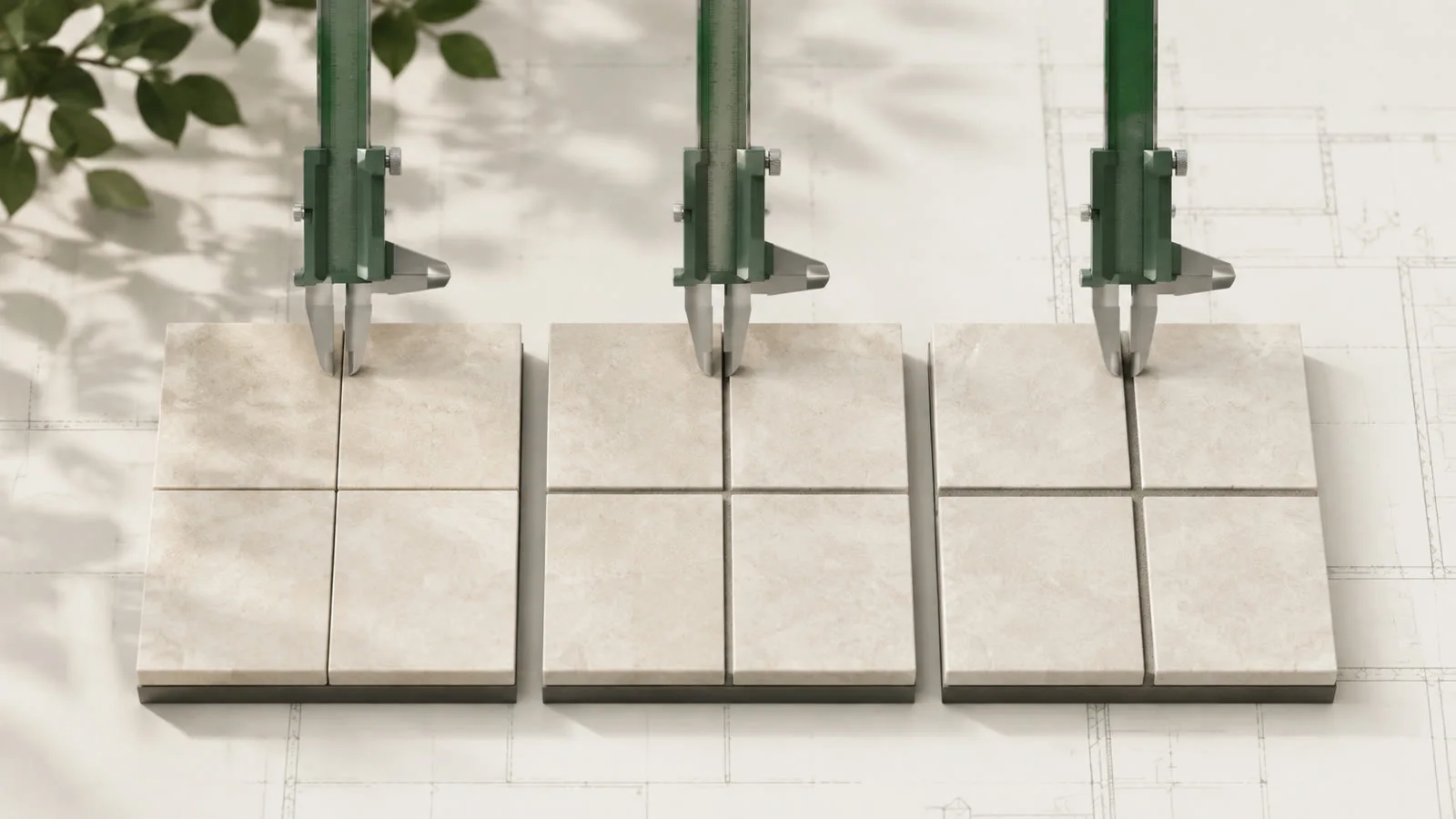
Why wider joints mean fewer tiles
That sounds wrong at first but is simple: it is not the tile that grows, it is the grid pitch. With 60 × 60 and a 2 mm joint it is 60.2 cm, with 5 mm it is 60.5 cm. Over ten rows that is three centimetres – usually irrelevant. But exactly when the room sits just above a multiple of the grid pitch, an entire row drops out.

What matters in practice

A threshold dimension in action
Our example bathroom measures 2.00 × 3.62 m. With a 2 mm joint, 3.62 m fits 6.01 grid pitches – so it needs seven rows, the last one just a centimetre wide. With 5 mm it is 5.98 pitches and therefore six rows. Result: 28 versus 24 tiles, a sixth less material, purely from three millimetres of joint.
The side effect matters more than the quantity
Look into the same calculation again: at 2 mm a border row of one centimetre remains. That is not only expensive, it is practically unlayable – such a strip breaks while cutting. Joint width is therefore rarely a saving lever but often a warning sign: if it changes the tile count, you have an edge problem.
You do not choose the joint freely anyway
In practice the joint width is dictated by format and edge: rectified large formats 2 to 3 mm, non-rectified goods 3 to 5 mm, outdoor terrace slabs 4 to 5 mm, porcelain in a gravel bed even more. The joint absorbs the tiles’ dimensional tolerances – narrowing it purely to save material gets you misaligned joint lines. Use the insight the other way round: if you are free between 3 and 5 mm anyway, check whether one variant saves a row.
Joint width across 500 rooms
The same 500 rooms, always 60 × 60, only the joint varies. The median barely moves – that is the actual news.
| Joint width | Median surplus | Top tenth | Above 10% |
|---|---|---|---|
| 1 mm | 10.1% | 23.3% | 51% |
| 2 mm | 10.1% | 23.3% | 51% |
| 3 mm | 10.1% | 23.3% | 51% |
| 5 mm | 10.1% | 22.5% | 50% |
| 8 mm | 9.8% | 22.5% | 48% |
Understanding the joint as a threshold
Almost every guide treats joint width as a linear factor. Our calculation shows it is a threshold that rarely tips and then does so by a whole row.
- In 93.5% of all room dimensions nothing changes between 2 and 5 mm
- When it does, a median of seven tiles fewer
- A wider joint always means fewer tiles, never more
- If the count changes you have an edge problem – not a saving opportunity
How to use this
1. Choose the joint by the tile
Rectified 2–3 mm, non-rectified 3–5 mm, outdoors 4–5 mm.
2. Check the threshold
Test both ends of the permissible range and watch the tile count.
3. Check the border width
If the quantity jumps, check the border row – that is where the real cause sits.
Examples from the tool
This is what it looks like planned out
The numbers above do not come from a spreadsheet but from a real layout. You can open these example projects directly – floor plan, laying plan and material list, exactly as the tool outputs them.

Format comparison: 60 × 60 vs 30 × 60
Two identically sized rooms side by side, only the format differs – each with its own row in the material table. Here the smaller format needs more material, because room dimensions decide, not tile size alone.
- 2 × 13.49 m² · 8% reserve
- 60 × 60 → 46 tiles = 16.6 m²
- 30 × 60 → 98 tiles = 17.6 m²

Small bathroom with tub and stud wall
Under 3 m² of floor left, but two cutouts: this room produces more cut tiles than full ones – exactly where the m² rule of thumb fails.
- 2.82 m² · 30 × 60 · 2 mm joint
- 9 full tiles, 22 cuts
- 35 tiles incl. 10% reserve
Opens the read-only client view of a share – the same one you create for your own projects with Premium.
Common questions
Does joint width change the number of tiles?
Usually not. In our sweep across 120,701 room dimensions the tile count stayed identical in 93.5% of cases when moving from 2 to 5 mm. In the remaining 6.5% an entire row drops out – a median of seven tiles.
Does a wider joint mean more or fewer tiles?
Always fewer, never more. A wider joint increases the grid pitch, so slightly fewer rows fit into the same room. In our sweep there was not a single case where a wider joint required more tiles.
Which joint width is the right one?
The one dictated by format and edge finish: rectified large format 2–3 mm, non-rectified 3–5 mm, outdoors 4–5 mm. The joint absorbs dimensional tolerances – chosen too narrow, the joint lines drift apart. Saving material is not a valid reason to narrow it.
Does the joint count towards the area?
To the room area yes, to the tile area no. That is why the calculated surplus can even dip slightly below zero with very well-fitting grids and wide joints – you then buy marginally less tile area than the room measures. In practice that is an arithmetic artefact, not a saving scheme.
Read on
- Where does the cut row go?The cut row has to go somewhere. Which wall can take it, how narrow a border strip may get, and how to see both on the floor plan before you glue.
- Large or small format?Eight formats, 500 rooms, the same room per run: 20×20 gets by with a median surplus of 0.3%, 60×120 needs 17.4%. The full comparison table.
- The 10% rule is wrong: 500 rooms analysedWe ran 500 floor plans through our laying engine. Result: real material surplus ranges from under 2% to over 58%. Method, tables and raw data to…
Check whether your room is at a threshold
Enter your room dimensions and switch the joint between 2 and 5 mm – if the count jumps, you are on a threshold.
The planning tool opens after free sign-up.