Vinyl guide
Laying vinyl flooring: click or glue-down?
Vinyl is versatile: warm underfoot, waterproof and easy to maintain. Whether you lay click vinyl floating or glue-down vinyl depends on substrate, moisture and your skill. We show both variants and how to calculate demand on the floor plan.
The planning tool opens after free sign-up.
By the floorplanning.app editorial team
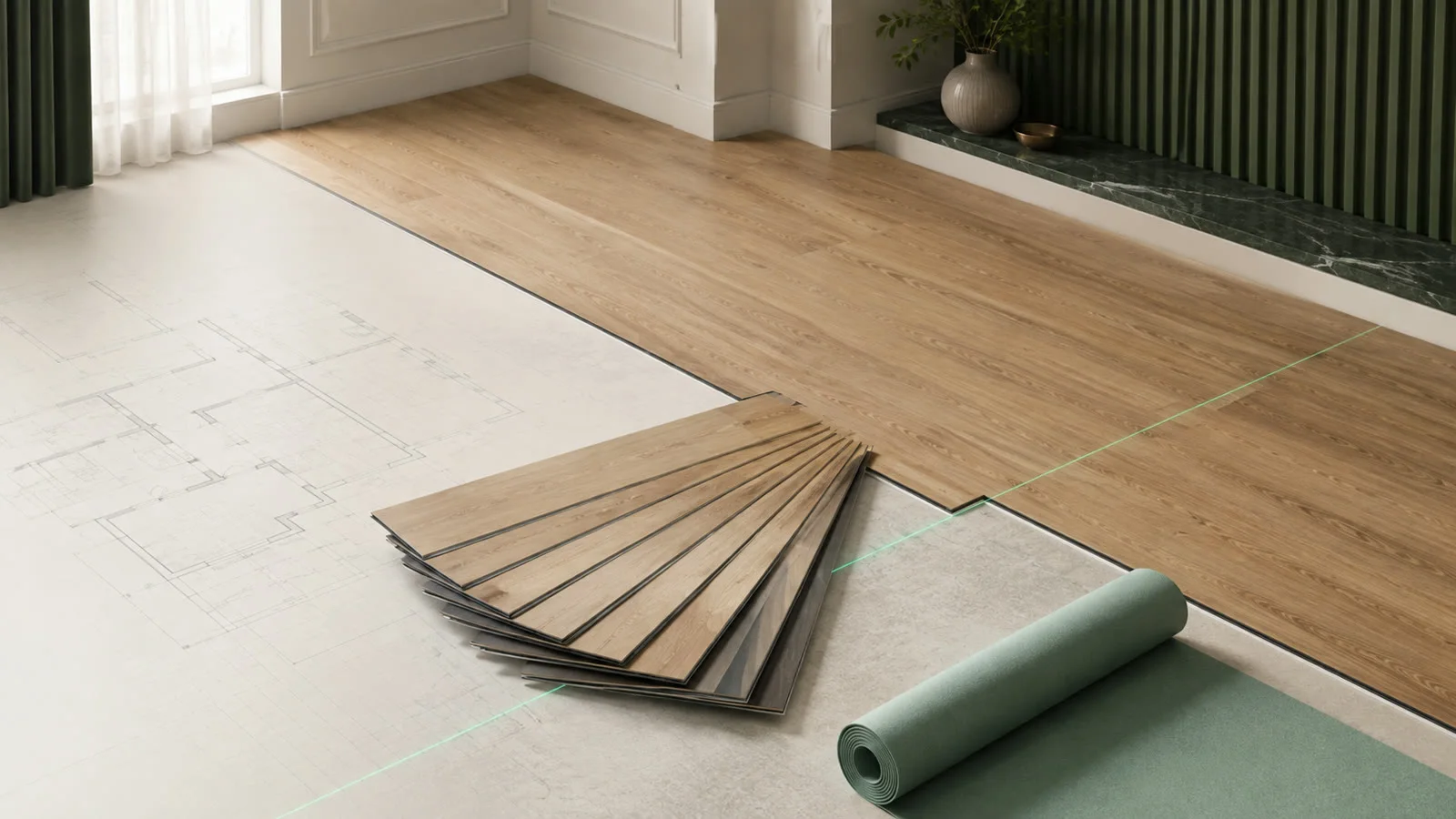
Click vinyl: quick and reversible
Click vinyl is laid as a floating floor like laminate. Impact sound insulation goes underneath and the planks click together. Ideal for rental flats because the floor is reversible. Allow 8–10 mm build-up for insulation and vinyl.

What matters in practice

Glue-down vinyl: thin and fixed
Glue-down vinyl is bonded directly to the substrate. It needs hardly any build-up – often only 2–3 mm – so it is perfect for doors with little clearance. But the substrate must be absolutely level because every irregularity shows through.
Mind direction and stagger
As with laminate, lay click vinyl along the light to hide the joints. Joints of neighbouring rows should be staggered by at least 30 cm. Glue-down vinyl needs the same stagger but cannot be corrected afterwards.

Calculate demand from the real room
Vinyl is sold in packs of whole planks. Instead of estimating square metres, the tool counts the planks needed including cuts and reserve. That tells you how many packs you really need.
Pack count instead of square metres
The result panel shows full planks, cuts and waste. Divide the plank count by the pack content, round up and you have the order quantity.
Laying vinyl flooring: key decisions
Click or glue, direction, insulation and stagger – clarify these points before you start.
- Click vinyl floating with impact sound insulation
- Glue-down vinyl directly on level substrate
- Lay along the light or the long wall
- Stagger joints by at least 30 cm
- Calculate plank demand including cuts and reserve
How to lay vinyl flooring
1. Check substrate and level if necessary
Level irregularities, remove dust, check moisture.
2. Choose click or glue-down
Click is faster and reversible, glue-down is thinner and fixed.
3. Prepare insulation or adhesive
Roll out impact sound insulation or apply adhesive with a notched trowel.
4. Align first row and lay planks
Set direction, align first row precisely, click onwards.
5. Order demand with reserve
Count planks from the floor plan, divide by pack content, round up.
Examples from the tool
This is what it looks like planned out
The numbers above do not come from a spreadsheet but from a real layout. You can open these example projects directly – floor plan, laying plan and material list, exactly as the tool outputs them.
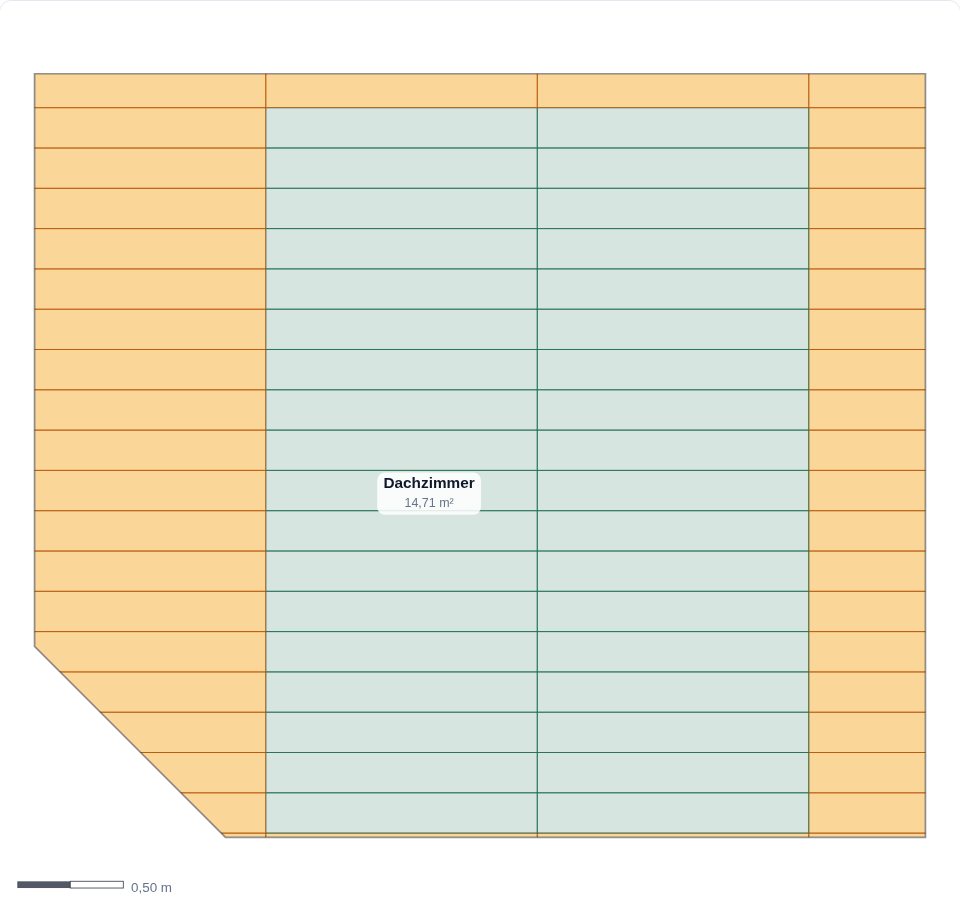
Living room with click vinyl
Click vinyl laid lengthwise along an angled wall – perimeter gaps, the final row and pack quantities remain traceable in the plan.
- 14.71 m² with an angled edge
- 122 × 18.2 cm plank, laid lengthwise
- 8% reserve · 6 planks per pack

Attic room with a slope
A five-sided outline instead of length × width: the slope is drawn as a real edge and the planks run lengthwise – every cut along the slope counted individually.
- 14.71 m² with an angled edge
- 128 × 19 cm plank, laid lengthwise
- 87 planks · 11 packs
Opens the read-only client view of a share – the same one you create for your own projects with Premium.
Common questions
Is click vinyl waterproof?
The surface is waterproof, but the joints usually are not. For showers and wet rooms glue-down vinyl or special click vinyl with a protective edge is the better choice.
Do I need impact sound insulation?
Yes for click vinyl, otherwise every step is audible and you may breach your lease. For glue-down vinyl it is not mandatory, but it noticeably improves the walking feel.
Can I lay vinyl over old tiles?
Yes, if the tiles are firmly bonded and the substrate is level. The joints should be filled with levelling compound beforehand so they do not show through.
How much waste does vinyl produce?
Similar to laminate: 5–10% for straight laying, more in rooms with many corners. In the tool you count the planks from the real floor plan.
How long should vinyl acclimatise?
Store for at least 24 hours in the room at 18–24 °C so the material adapts to temperature and humidity.
Related calculators & guides
- Laminate laying directionFind the right laminate flooring direction for light, room shape, doors, and joints. Preview the layout and avoid narrow edge strips before laying.
- Laminate calculatorCalculate laminate and vinyl online. Enter room and plank dimensions, compare laying directions, and get quantities including waste and reserve.
- How much laminate do I need?Calculate laminate demand: count planks instead of square metres, derive waste from the real room and determine the number of packs including reserve.
Calculate vinyl demand now
Create your room, enter the plank format and see how many packs you need for your project.
The planning tool opens after free sign-up.